PLT012:

A First-in-Class “Gatekeeper” selectively blocking lipid-driven dysfunction in MASH

Immunotherapy
Pipelines

Indication

Discovery

IND-enabling
Development

First-in-Human
Study

Proof-of-Concept
Human Study

PLT012 anti-CD36
Monoclonal Antibody

Solid Tumors
(HCC, CRC)

Metabolic & Autoimmune Diseases

FY2025

FY2026

FY2027

FY2027

Target

Discovery

IND-enabling Development

Phase 1/2

Phase 3/4

PLT012M
CD36
Chronic Liver Diseases

CD36-mediated lipid uptake drives steatosis, inflammation, and fibrosis

CD36, a fatty acid transporter, is upregulated across hepatocytes and liver-resident immune and stromal cells in metabolic dysfunction–associated steatohepatitis, enabling adaptation to a lipid-rich hepatic microenvironment. CD36-driven lipid uptake promotes hepatocellular stress, inflammatory macrophage activation, endothelial dysfunction, and fibrogenic signaling, collectively reinforcing a pro-inflammatory and pro-fibrotic state.
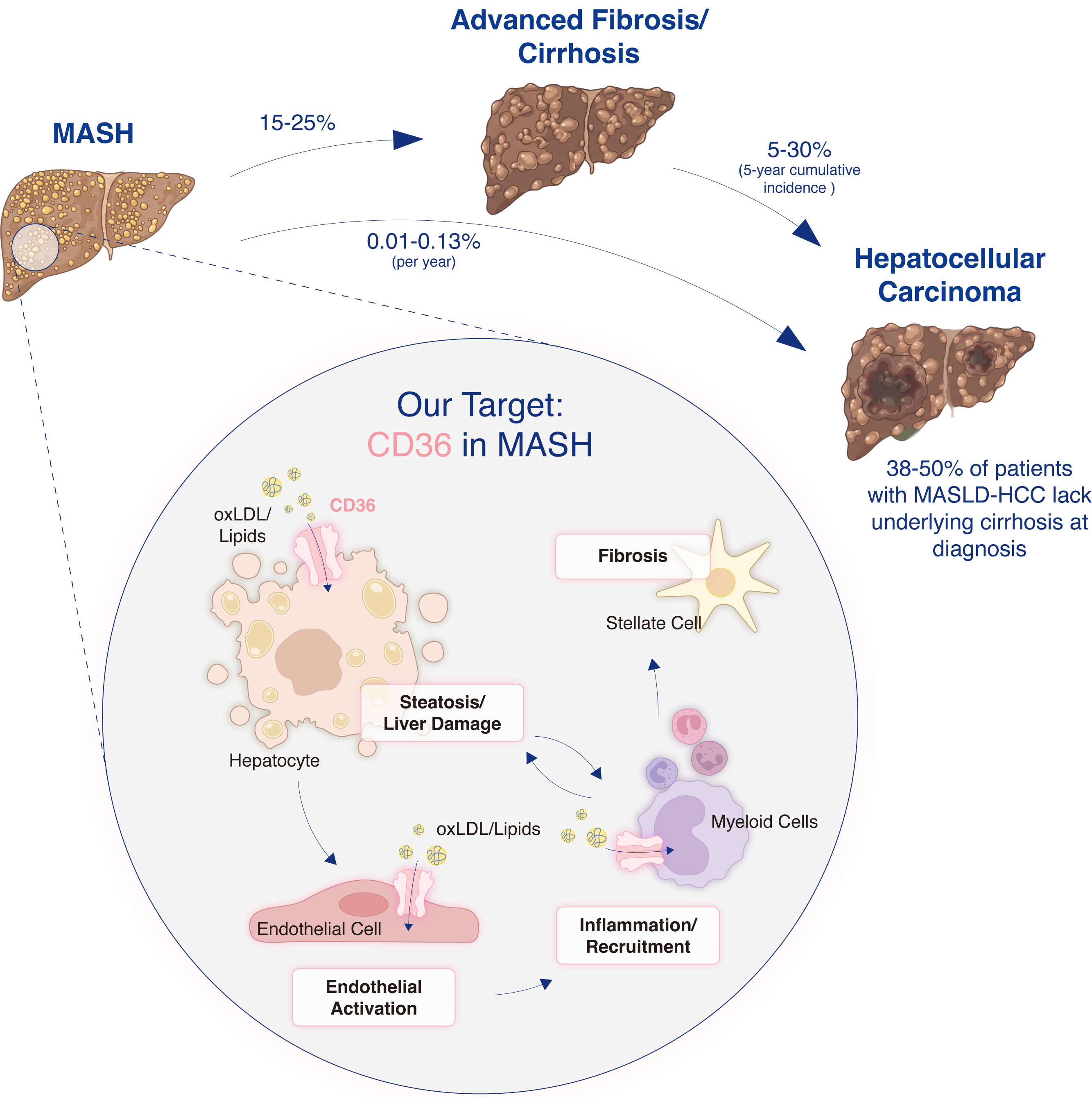
The MASH-HCC Disease Continuum

PLT012: Reprogramming Lipid-Driven Disease Biology

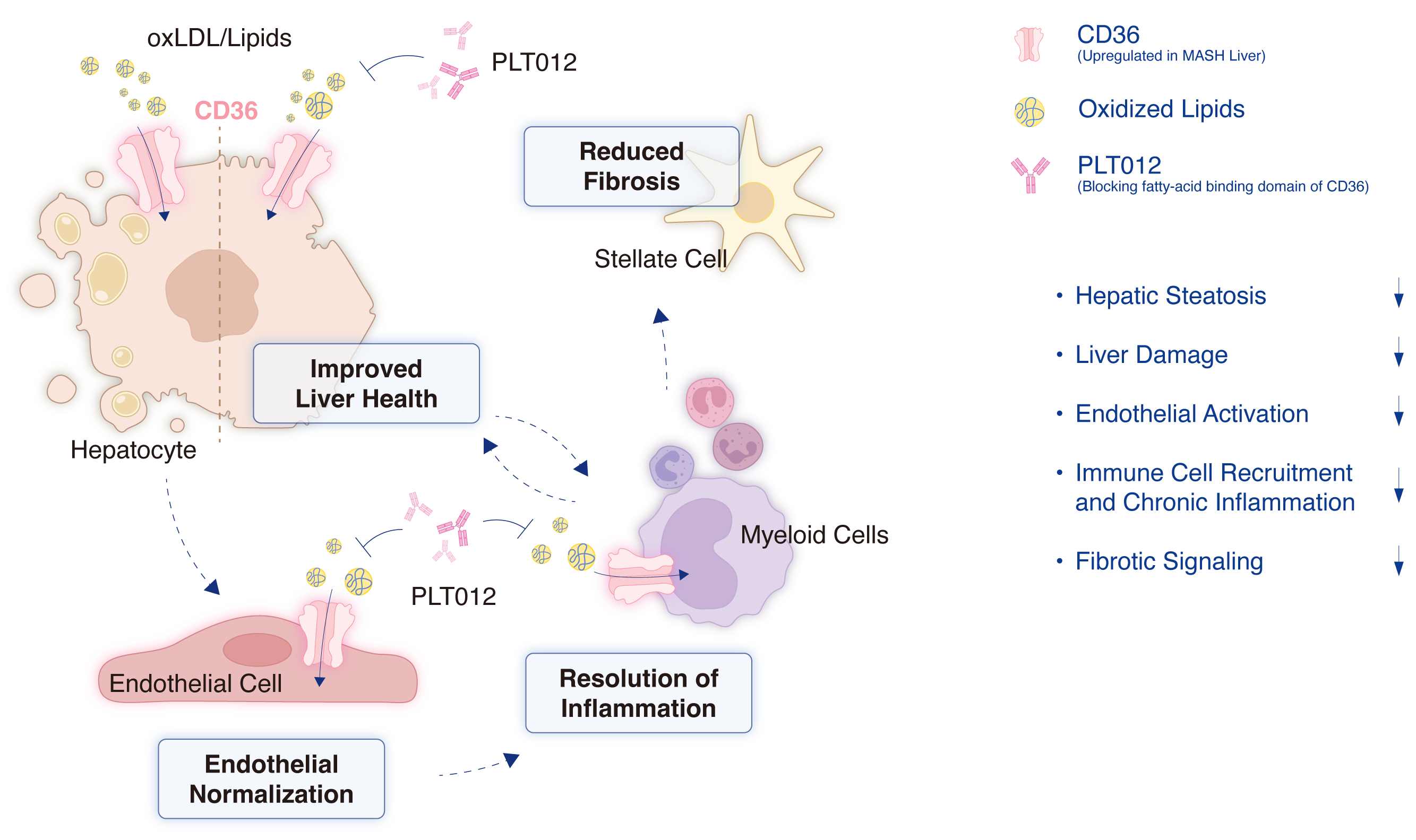
PLT012 is designed to block CD36-mediated lipid uptake and interrupt a central driver of MASH progression. By limiting pathologic lipid influx into hepatocytes, PLT012 reduces steatosis and hepatocellular stress, helping prevent the cycle of lipotoxic injury that drives liver damage. In parallel, CD36 inhibition suppresses chronic inflammation by reducing endothelial activation and downstream immune cell recruitment into the liver. PLT012 also attenuates pro-fibrotic signaling by reshaping macrophage-driven inflammatory responses, reducing the signals that promote stellate cell activation and collagen deposition. Through this integrated mechanism, PLT012 is designed to address the core pathological drivers of MASH-steatosis, inflammation, and fibrosis—with the goal of slowing or preventing disease progression.
Key Features

FDA Orphan Drug Designation

Granted for liver and intrahepatic bile duct cancers, providing 7 years of market exclusivity upon approval

Expanded Access Policy

Pilatus Biosciences is committed to developing investigational therapies through carefully controlled clinical trials designed to evaluate safety and effectiveness.
At this time, Pilatus Biosciences does not offer expanded access (also known as compassionate use) to its investigational products outside of ongoing clinical trials.
We believe that participation in clinical trials is the most appropriate way to access investigational therapies when ensuring patient safety and generating the data necessary for regulatory review.
Information about our active trials is available at www.clinicaltrials.gov. (NCT07337525)
This policy may be updated as our development programs progress.

Preclinical Efficacy

Demonstrated single-agent anti-tumor activity in both immune-hot and immune-cold tumor models.

Combination Potential

Scientific findings suggest synergizing with ICIs like PD-1/PD-L1 inhibitors.

Excellent Drug Developability

PLT012 has favorable preclinical safety profile and robust manufacturing productivity.

Scientific Reference

CD36-mediated metabolic adaptation supports regulatory T cell survival and function in tumors.

Nature Immunology, Ping-Chih Ho et al., 2020

CD36-mediated metabolic adaptation supports regulatory T cell survival and function in tumors.

Nature Immunology, Ping-Chih Ho et al., 2020

Uptake of oxidized lipids by the scavenger receptor CD36 promotes lipid peroxidation and dysfunction in CD8+ T cells in tumors.

Immunity, Ping-Chih Ho et al., 2021

Uptake of oxidized lipids by the scavenger receptor CD36 promotes lipid peroxidation and dysfunction in CD8+ T cells in tumors.

Immunity, Ping-Chih Ho et al., 2021

Metabolic communication in the tumour–immune microenvironment.

Nature Cell Biology, Ping-Chih Ho et al., 2022

Metabolic communication in the tumour–immune microenvironment.

Nature Cell Biology, Ping-Chih Ho et al., 2022

Metabolic programs tailor T cell immunity in viral infection, cancer, and aging.

‍Cell Metabolism, Yi-Ru Yu, Ping-Chih Ho, et al., 2022

Metabolic programs tailor T cell immunity in viral infection, cancer, and aging.

‍Cell Metabolism, Yi-Ru Yu, Ping-Chih Ho, et al., 2022

PLT012, a monoclonal antibody targeting CD36, unleashes anti-tumor immunity via metabolic reprogramming in tumor microenvironment.

‍SITC, 2023 (Poster is available upon request).

PLT012, a monoclonal antibody targeting CD36, unleashes anti-tumor immunity via metabolic reprogramming in tumor microenvironment.

‍SITC, 2023 (Poster is available upon request).

Revitalizing Anti-Tumor Immunity Through PLT012 Monoclonal Antibody, Targeting CD36 for Metabolic Rewiring in the Tumor Microenvironment.

‍AACR Annual Meeting, 2024 (Poster is available upon request).

Revitalizing Anti-Tumor Immunity Through PLT012 Monoclonal Antibody, Targeting CD36 for Metabolic Rewiring in the Tumor Microenvironment.

‍AACR Annual Meeting, 2024 (Poster is available upon request).

PLT012: A First-in-class Antibody Targeting CD36, Revolutionizing Immunotherapy by Unleashing Anti-Tumor Immunity through Metabolic Reprogramming in the Tumor Microenvironment.

‍SITC, 2024 (Poster is available upon request).

PLT012: A First-in-class Antibody Targeting CD36, Revolutionizing Immunotherapy by Unleashing Anti-Tumor Immunity through Metabolic Reprogramming in the Tumor Microenvironment.

‍SITC, 2024 (Poster is available upon request).

PLT012, a Humanized CD36-blocking Antibody, is Effective for Unleashing Anti-tumor Immunity in Fatty Acid-enriched Tumor Microenvironment.

‍AACR Annual Meeting, 2025 (Poster is available upon request).

PLT012, a Humanized CD36-blocking Antibody, is Effective for Unleashing Anti-tumor Immunity in Fatty Acid-enriched Tumor Microenvironment.

‍AACR Annual Meeting, 2025 (Poster is available upon request).

PLT012, a Humanized CD36-blocking Antibody, Is Effective for Unleashing Antitumor Immunity Against Liver Cancer and Liver Metastasis

‍Cancer Discovery, Ping-Chih Ho et. al., 2025

PLT012, a Humanized CD36-blocking Antibody, Is Effective for Unleashing Antitumor Immunity Against Liver Cancer and Liver Metastasis

‍Cancer Discovery, Ping-Chih Ho et. al., 2025